
Stop Overpaying for Under-Engineering: A Client's Guide to Cost-Smart Design
For developers, architects, and planners, the success of a project is measured in more than just approvals and finished construction. It is measured in dollars. Every design decision made during the engineering phase of a project has a direct and often substantial impact on the final construction budget. Understanding this relationship, and choosing an engineering partner who treats cost efficiency as a core design principle rather than an afterthought, can be one of the most financially significant decisions a client makes.
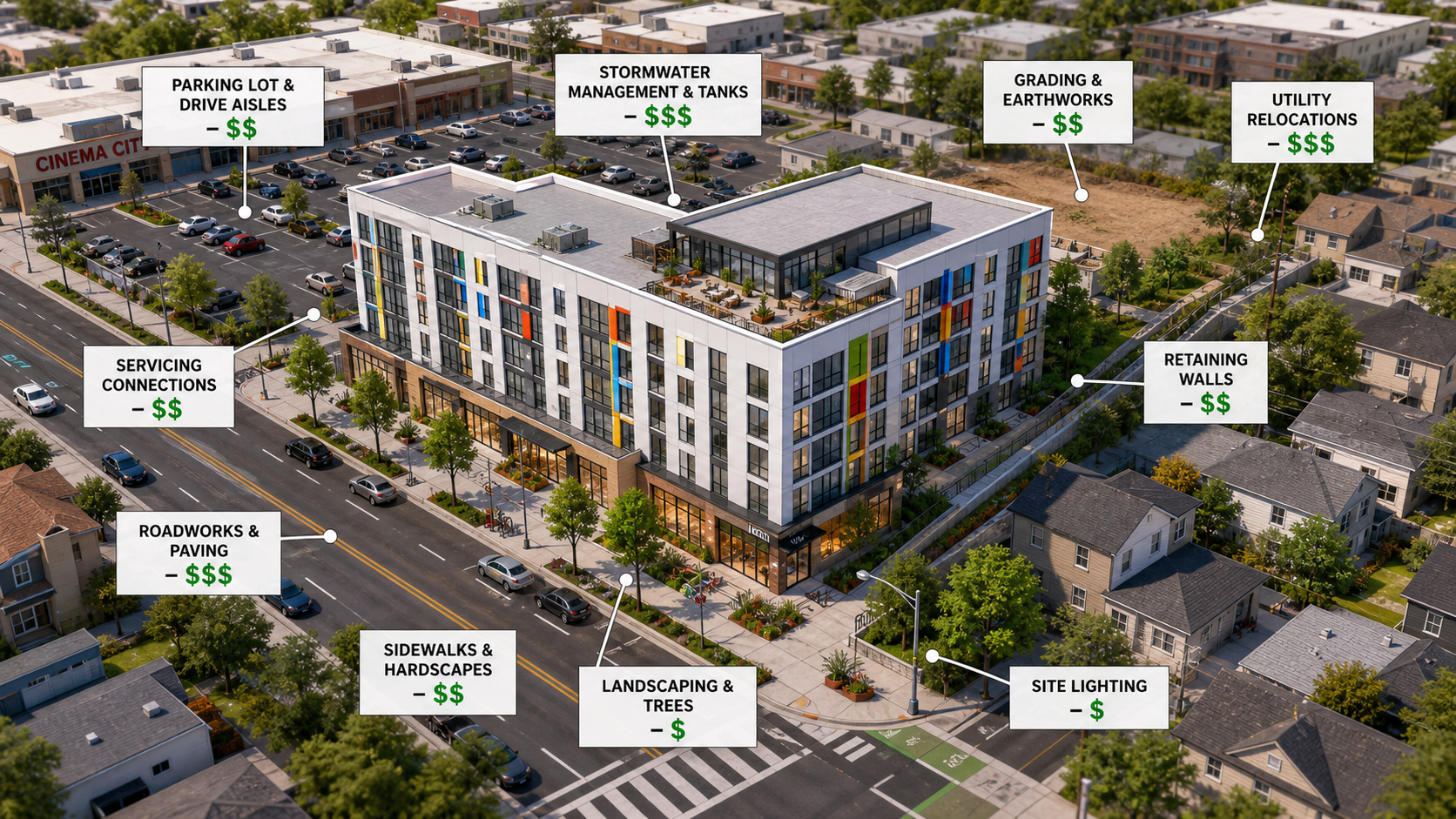
A schematic representation of the costs of civil engineering.
Design Decisions Are Cost Decisions
Civil engineering is often thought of as a technical discipline concerned primarily with function and compliance: does the stormwater drain properly, does the site meet grading standards, will the servicing pass municipal review? These are essential questions, but they are only part of the picture. Every technical solution to a design problem carries a price tag, and that price tag is determined long before construction begins.
This means the value an engineer brings to a project is not just measured by whether a design works. It is measured by whether the design works efficiently, and minimizes labour, material, and maintenance costs, to achieve a durable, standards-compliant result. An engineer with deeper knowledge can often achieve the same functional outcome as a less experienced counterpart, at a fraction of the cost, simply by understanding how design choices translate into real-world installation expenses.
The Right Order of Priorities
A well-designed project can save clients tens or even hundreds of thousands of dollars over the course of construction. But cost savings only have value when they are pursued in the correct order of priorities. Every design decision should be filtered through three sequential questions:
Will the design actually work, and will it stand the test of time? A design that fails prematurely is not a design at all. It is a liability.
Does the design meet or exceed applicable engineering standards? Regulatory approval is not optional, and cutting corners here creates risk that far outweighs any short-term savings.
Has the design been optimized to minimize cost? What materials, construction methods, modelling software, suppliers, etc. do we have available to minimize the cost.
This ordering matters enormously. When priorities are followed correctly, clients receive exactly what they expect: a design that performs reliably, satisfies the reviewing agency, and costs as little as possible to build.

A proposed multi-storey development in Hamilton, ON. Cost minimizing design was applied to the site to replace 4 catch basins with a single trench drain. Coupled with a grading design that removed a retaining wall, the developer saved nearly $60,000 in construction costs.
Why Expertise Is the Real Cost-Saving Tool
Achieving genuine cost savings, without compromising function or compliance, requires a level of technical knowledge that goes beyond textbook familiarity with design standards. It requires engineers who understand their subject matter deeply enough to see multiple valid paths to the same regulatory outcome, and who can judge which of those paths is the most economical to build.
In land development engineering specifically, this expertise centers on three interconnected disciplines: grading, servicing, and stormwater management. An engineer who truly understands how to grade a site knows how subtle adjustments in slope and layout can eliminate the need for costly infrastructure altogether. An engineer with command of the applicable standards, often more thorough than the reviewers evaluating the plans, can confidently design at the most efficient edge of what is permitted, rather than over-building out of caution or uncertainty. And an engineer who understands the real-world cost of materials and labor can translate design choices into dollar figures before a single shovel hits the ground.
This is the kind of expertise that pays for itself many times over.
A Real-World Example: The Cost of Sewer Layout
Consider a common scenario in land development: a medium sized site with two low areas, each requiring its own stormwater inlet, or catch basin, to capture runoff.
If these two inlets are simply connected in a row along the same pipe run, the applicable engineering standards require that the second inlet be upgraded to a catch basin maintenance hole, a structure with additional access and maintenance features required whenever a pipe run continues downstream from an existing structure. At typical scale, a standard catch basin costs approximately $2,500 to supply and install. A catch basin maintenance hole, by contrast, costs approximately $10,000, nearly four times as much, for the same basic function of capturing runoff.
Now consider an alternative approach: rather than routing the two inlets in a single line, the grading and sewer network are arranged so that each inlet reaches the outlet independently. The site still functions exactly as intended. Both low areas still drain properly. The design still meets every applicable standard. But by eliminating the need for the more expensive structure, the project saves $7,500, on a single design decision, on a single pair of structures.
Now multiply that kind of decision across an entire site plan, with dozens of grading and servicing choices, and the cumulative impact becomes clear. This is not a marginal efficiency. It is the difference between a design that merely satisfies requirements and a design that actively protects a client's bottom line.

A design in southern Ontario where clever use of a landscape wall eliminated the need for stormwater pumping. The design saved approximately $15,000 in construction costs and the congoing costs to operate and maintain a stormwater pump.
What Clients Should Expect From Their Engineer
For developers, architects, and planners evaluating a civil engineering partner, this example illustrates an important standard to hold your design team to. A qualified engineer should not only produce a design that works and secures approval. They should be able to demonstrate, with real cost estimates covering both materials and labor, that the design has been optimized for construction cost as well as technical performance.
When evaluating proposals or engineering partners, clients should feel empowered to ask directly: Has this design been reviewed for cost efficiency, and can you show me the estimate? An engineer confident in their design should welcome that question, because the answer is where genuine value becomes visible.
The Bottom Line
Cost-conscious civil engineering is not about cutting corners. It is about depth of expertise applied in the right order: build something that works, build it to standard, build it as economically as possible. When these priorities are respected, clients get precisely what they are paying for, a design that performs, a design that is approved, and a design that costs no more than it has to. That combination is not a compromise. It is the standard our clients should expect, and it is the standard we deliver on every project.
